



Mikaitis talks community outreach, collaborations to mitigate challenges of upcoming Medicaid changes
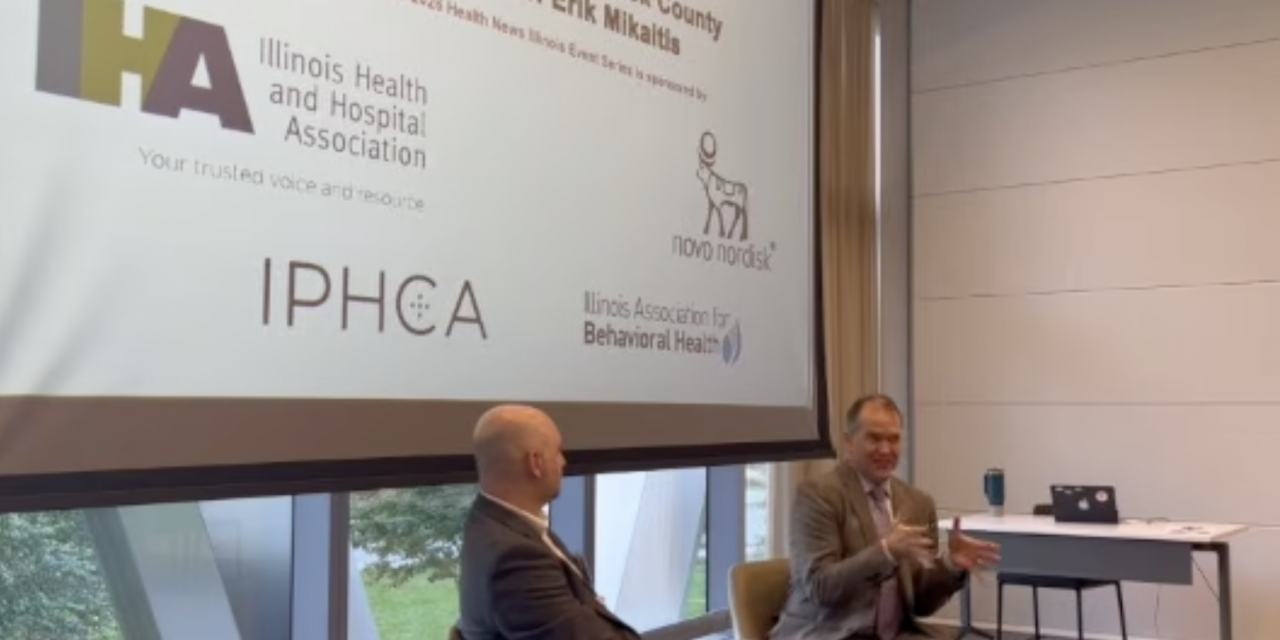
Cook County Health CEO Dr. Erik Mikaitis sat down with Health News Illinois in Chicago this week to discuss a wide range of topics as the health system prepares for major changes happening to the Medicaid program and the larger safety net.
Topics include how the health system is navigating the Medicaid changes, which include work requirements and twice-a-year redeterminations starting next year, communicating those changes to the community and the longer-term financial impact.
Watch the full event on our YouTube page here. Read more about the discussion on the impact on Chicago’s safety net ecosystem here.
Edited excerpts below:
HNI: How is Cook County Health navigating all these changes?
Dr. Erik Mikaitis: There’s internal and external work that’s happening. There’s been a lot of belt-tightening over the last three years, and the CCH team has felt it and has been a part of that effort. It’s really improving our operations, expanding access, how we’re running our procedural units and making sure that you know specialty care that we’re able to schedule in as efficiently as possible. It’s working on partnerships, ensuring that our network is as tight as possible. And then on the external side, really working with our community partners. We launched the Medicaid Impact Work Group back in September of 2025. We welcome anybody else to join the conversation. It meets essentially quarterly; it started with about 60 organizations, and we were very intentional about not just limiting the discussion to the healthcare space. We actually expanded much more broadly. We had academic leaders. We had business and technology leaders, philanthropy, community organizations; a really, really kind of big tent, if you will, to bring a diverse voice and experience into the conversation. The thinking there was that we get a much more innovative and fulsome discussion around how we can mitigate the impacts of all these policy changes. We’ve spun out three work groups: communicate and educate, which we’ll get into in a little bit, coalition building, and then innovation. So a lot of work is happening in those three spaces as well through the work groups.
So a few of the areas that we’ve been trying to mitigate the impacts right now, and then brace for impact internally. We’ve seen a lot of shifts in the financials and the uninsured payer mix. So working on all of those internal pieces, the belt-tightening there as well, we have been able to remove over $300 million in costs out of the health system budget.
HNI: As certain immigrant populations lose health coverage, what are some of the challenges faced reaching them to let them know about the change and what they can do to ensure care access?
Dr. Erik Mikaitis: It’s communication, and it’s awareness. Going back to a study, more than half are unaware of work requirements, and 85 percent are unaware of redetermination. It’s ensuring that people know where to go and that they understand what the changes are. For this group, it’s ensuring that they stay engaged in their care, that they understand what their options are, and that they’re able to still seek out care. We had a patient and a health plan member both come to a press conference last week where she had not engaged in care. She thought she had the flu and went to urgent care. She lost her insurance coverage and found out that she had completely uncontrolled diabetes, needing hospitalization for uncontrolled diabetes. So she presented, and they gave her Stroger (Hospital’s) address. She came to us, and thankfully, it’s clicking all the boxes to keep your coverage. We were able to get her enrolled in CountyCare, so now she’s both a patient and a member of ours.
HNI: How could the changes affect CountyCare and its enrollees?
Dr. Erik Mikaitis: So unfortunately, it’s already affecting CountyCare. I mentioned at the beginning that the (Affordable Care Act) tax subsidies have impacted our risk pool, as you might imagine. People who see a big increase in their out-of-pocket costs and aren’t really engaging in care, that might go once a year or every other year for a (primary care provider) visit — those are the folks who are making that kind of utility decision of, ‘Am I going to pay twice as much out of pocket for something I use every other year?’ Those are the ones that we’re tending to lose, and those are our lower-cost, lower utilizers. You think of it like a bell curve, where you’ve got the high cost, high utilizers at one end, and then the low cost, low utilizers at the other. We get premium payments for all of them, right, and as you get to the higher cost, higher utilizers, the sicker population, right? You tend to subsidize their care with the margins that you get from the healthier patients. So when you lop off this end of the bell curve, now suddenly you’re only getting kind of the sicker, high-utilizer care, and that’s kind of the side that you’re upside down on. So it creates incredible financial pressure for the health plan to continue operating. They’ve done a lot of really great work with contract renegotiations, thinking about value-based care and how we shift some of those structures. We’re on a nice glide path now. They’ve done a really nice job trying to absorb those shifts. It takes a year or two for all of that to communicate and catch up, so that we are getting the appropriate kind of premiums for our risk pool.
HNI: What are some of the communication efforts going on?
Dr. Erik Mikaitis: So coming back to the impact work group, we have the communicate and educate group where we’ve now launched a microsite called GetMedicaidFacts.com. That website offers a link out to HFS’s site directly, where patients can validate their information on file with the state, update if it’s incorrect and make sure that if they’ve moved, they can update their address. There’s a calendar of events, and our CountyCare team does almost daily redetermination events. They do about 20 to 25 a month to make sure that people have the help they need to stay on, so there’s a calendar of events there, so people can go to the website and see where they can get some help staying enrolled. And then there’s a very robust FAQ for patients to understand the policy changes that are coming. There’s also a community partner-facing piece of the website where there are toolkits that people can download for free. It’s in 14 languages. It isn’t branded to CCH. In fact, we’re encouraging our community partners to brand their organization. We think it adds a layer of trust for people receiving the information. If it’s your church, if it’s your employer, if it’s your healthcare provider, maybe a small independent practice in an underserved community, right? But if it’s your doctors giving you this, it tends to hit a little more. So we’re really encouraging and trying to get the word out to get people to start using the toolkit, download it, and then share it in their community. We’re looking for opportunities to amplify the website.
HNI: How did the working groups come about? What other projects are they doing?
Dr. Erik Mikaitis: The impact work group really came from internal conversations at CCH and the realization that we’re not powerless. We don’t have to sit back and let all these changes happen and see what happens to the communities that we’re serving. So really, trying to step in and take a more active role. I spoke about the broader tent, we really want diverse inputs in terms of how we respond. There are two other subgroups: coalition building, where I’m very happy and excited to share that we started with 60 organizations. We’ve now grown to about 200 organizations participating in the conversation. And just in our last meeting, we had 100 faith-based religious leaders in the southland of Chicago join us remotely. One hundred of them in a room together, which is just so exciting to have that type of growth. So that’s the work that the coalition-building team is doing. Then the innovation team right now is literally focused on ensuring that data is flowing tightly and that we’re getting provider-to-state-level data. There’s a lot of kind of claims processing and signaling to the state that needs to happen to make sure people can continue to keep their coverage. You know, there’s this idea of medical frailty that is kind of a moving definition at the federal level. The state is still trying to figure out what they can do there. But for awareness, if you’re deemed medically frail, it gets you off that treadmill of having to do twice-a-year redetermination, having to do the work requirements. So really, as those details come together, our innovation team is making sure that providers understand what the state needs to see to keep an open line of communication and making sure that we’re not having technical issues that cause people to fall off.
HNI: What is the longer-term financial picture here for Cook County Health?
Dr. Erik Mikaitis: So we have out-year projections to the tune of about another $100, $115 million through the early 2030, 2031 timeframe. So continuing to work to absorb those cuts, those reductions, and work on improving our operations. There’s still more meat on those bones in terms of improving operations, fixing the revenue cycle, putting in foundational systems that’ll help us have a better sense and better control over our expenses and all of that. So a lot more foundational work happening at that whole system that I’m hopeful we’ll be able to, over the next four or five years, continue to close that gap.
HNI: As you work on communication, have you found anything that’s most effective as far as reaching out to the patients?
Dr. Erik Mikaitis: I think we’ve really focused more on the provider and the community space. I think getting non-healthcare community partners to really understand their role in the game. A small safety net in a community that could be an economic driver for that community. You’ve got restaurants next door, you’ve got the dry cleaners across the street, and you’re bringing 1000 employees in every day to work at that hospital. That hospital closes. Those secondary businesses are all going to suffer too. So getting the business community engaged and getting them to understand, through the right lens, what their impact might end up being on the chambers of commerce and business owners. Same thing with labor. Finding the right kind of angle to engage in those discussions. I think that’s been a lot more the focus right now. It’s been an amplification effort to make sure that as many people as possible are banging the drum.